

A torn rotator cuff on the warehouse floor. A back injury from lifting a patient. A fall from scaffolding on a construction site in Bibb County. The injury itself is only the beginning. What happens in the days and weeks afterward often determines whether Georgia’s workers’ compensation system works for you or against you.
The process is not intuitive. Deadlines are strict, the rules around medical care are specific, and insurance companies have their own playbook. Most injured workers in Macon and Middle Georgia don’t lose their claims because they lack a valid case. They lose because they didn’t know the procedural steps that protect it.
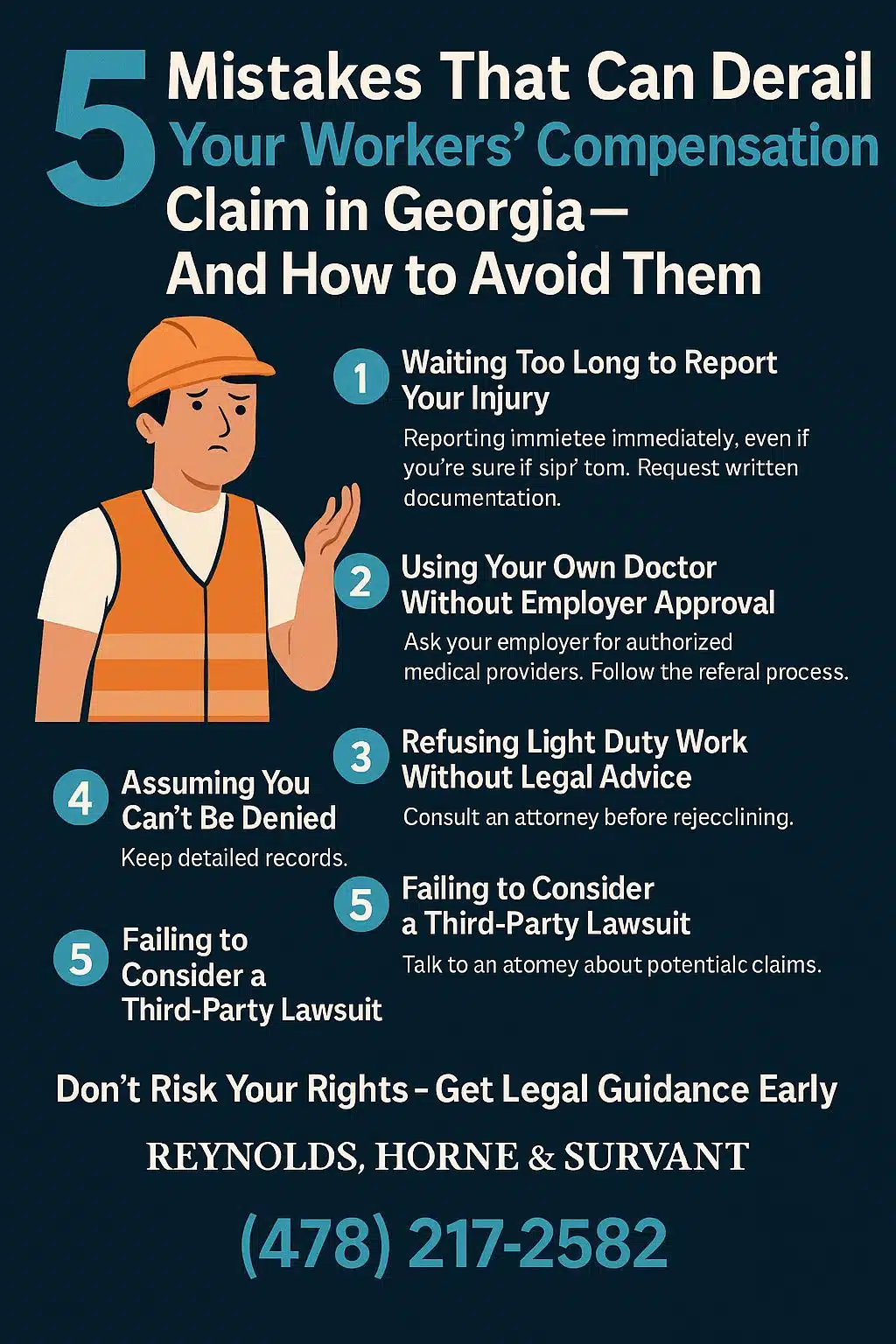
At Reynolds, Horne & Survant, we’ve seen how small procedural missteps early in the process can cost injured workers the benefits they’re entitled to. These are five of the most common mistakes, and the specific steps you can take to avoid each one.
1. Reporting Your Injury the Wrong Way (or Too Late)
In Georgia, reporting your injury means two things: notifying your employer within 30 days and creating a written record of what happened.
Georgia law gives you 30 days to notify your employer of a workplace injury (O.C.G.A. § 34-9-80). That sounds like plenty of time. It isn’t.
Insurers routinely use delayed reporting to argue that an injury didn’t happen at work or wasn’t serious. But timing is only half the problem. How you report matters just as much.
A verbal report is legally valid, but it creates no record. If your employer later disputes that you told them, it becomes your word against theirs. A written report, even a simple email or text message, creates a timestamp and a paper trail that an insurer cannot easily dismiss.
There’s another deadline most workers don’t know about: you have one year from the date of injury to file a formal claim with the Georgia State Board of Workers’ Compensation using Form WC-14 (O.C.G.A. § 34-9-82). When you file Form WC-14, you also need to send a copy to your employer and the insurer. The 30-day notice and the one-year filing deadline are separate requirements. Missing either one can end your claim.
Quick reference: reporting your injury
- ✓ Notify your supervisor in writing (email, text, or written note) as soon as possible
- ✓ Include the date, time, location, and a brief description of what happened
- ✓ Ask for written confirmation that your report was received
- ✓ Keep your own copy of everything you send
2. Choosing the Wrong Doctor (or Not Knowing You Can Switch)
Georgia’s workers’ compensation system does not give you free choice of physician. Your employer is required to post an approved panel of physicians in a visible location at the workplace, and a traditional panel includes at least six doctors (O.C.G.A. § 34-9-200). You must choose your treating physician from that list.
If you see your own doctor without following the panel rules, the insurer may refuse to pay for your treatment. That’s not a technicality. That’s a denied medical claim.
But here’s what many injured workers don’t realize: you have the right to make one change to a different physician on the panel without needing your employer’s permission (O.C.G.A. § 34-9-201). One switch. No approval required. If the treatment you’re receiving feels inadequate, or if your doctor isn’t taking your injury seriously, you don’t have to stay.
Ask your employer for the panel list. If it wasn’t posted or you were never told about it, that matters. If the panel was not properly posted or explained, that can affect which treatment rules apply. A workers’ compensation lawyer in Macon, GA can help you understand how those rules affect your medical care options.
If you’re asked to attend an Independent Medical Examination (IME), bring your medical records, a list of your symptoms, and be honest about your limitations, but know that this doctor was selected by the insurer.
3. Failing to Build a Paper Trail
Filing a claim is not enough. If your documentation has gaps, the insurance company will find them.
Adjusters look for inconsistencies. A missing medical bill. A gap between the injury date and your first medical visit that raises questions about when the injury actually occurred. An email you sent your supervisor that contradicts what you told the adjuster. These details matter because they become the evidence your claim is built on, or the evidence used to tear it apart.
What should you be documenting? Everything connected to your injury and its aftermath:
- Medical bills, prescriptions, and treatment summaries
- Mileage logs for every trip to a medical appointment
- Written communications with your employer (emails, texts, letters)
- Work restriction letters from your treating physician
- Any correspondence from the insurance company or its representatives
- A personal timeline: dates of the injury, reports, treatments, and any changes in your condition
Keep digital copies of everything. Photograph paper documents. Save emails in a dedicated folder. Timestamp matters: a document you can prove existed on a specific date is far more valuable than one you reconstruct from memory months later.
4. Underestimating the Insurance Company
The phone rings a few days after your injury. The voice on the other end is polite, maybe even sympathetic. They ask how you’re doing. They want to hear what happened, in your own words.
This is a recorded statement, and it is not a casual conversation. The adjuster’s job is to gather information that the insurer can use to minimize or deny your claim. A poorly worded answer, an offhand comment about feeling “a little better,” a detail that doesn’t perfectly match your initial report: any of these can be used against you later.
Before giving a recorded statement, many injured workers choose to get legal advice so they understand how that statement may be used later.
That’s only the first stage of how insurers evaluate your claim. Settlement pressure often follows. After weeks of medical bills and missed paychecks, a lump-sum offer can feel like relief. But early settlement offers rarely account for ongoing treatment, future surgeries, or the long-term impact of a permanent injury. Once you accept, it’s final.
Georgia law requires that all workers’ compensation settlements be approved by the State Board of Workers’ Compensation (O.C.G.A. § 34-9-15). That approval process exists to protect injured workers from agreements that undervalue their claims. But the Board reviews what’s presented to it. If you accept a low offer without understanding what your claim is actually worth, the approval process alone won’t save you.
If you’re being pressured to settle, or if you’re unsure whether an offer reflects the full value of your claim, getting legal advice before signing anything is a critical step.
5. What to Do If Your Claim Is Denied
A denial letter does not mean your case is over. It means the insurer decided not to pay, and in Georgia, you have the right to challenge that decision through the State Board process.
If your claim is denied, you can request a hearing before an Administrative Law Judge at the Georgia State Board of Workers’ Compensation (O.C.G.A. § 34-9-100). The hearing process gives you the opportunity to present medical evidence, witness testimony, and legal arguments that the initial review may not have considered.
Denials happen for many reasons: disputed facts, incomplete documentation, disagreements about whether the injury was work-related, or pre-existing conditions that the insurer claims are the real cause of your symptoms. That last one catches many workers off guard. But Georgia law recognizes that a workplace accident can aggravate a pre-existing condition, and that aggravation may still be compensable. Having a prior back injury, for example, does not automatically disqualify you from receiving benefits for a new injury to the same area.
In many cases, the next step is not starting over, but formally requesting a hearing and organizing the medical records and timeline that support your position.
The deadline to request a hearing matters, and the timing may depend on where your claim stands. If you’ve received a denial, speaking with an experienced Macon workers’ compensation attorney promptly allows you to explore your legal options before that window closes.
Workers’ compensation claims are won or lost in the details: how you report the injury, which doctor you choose, and what you sign at the end. The steps are specific, and they matter.
If you’ve been injured on the job in Georgia, the injury lawyers in Macon at Reynolds, Horne & Survant can help you protect your claim from the start. Call (478) 217-2582 to schedule a free consultation. We represent injured workers throughout Macon and Middle Georgia.
The information in this blog post is for general informational purposes only and does not constitute legal advice. Reading this content does not create an attorney-client relationship. Every case is different, and outcomes depend on the specific facts and circumstances involved. If you need legal advice, contact a qualified attorney licensed in your jurisdiction.